“Where you look affects how you feel.”
David Grand, Ph.D.
🧠 What is Brainspotting?
Brainspotting is a modality I have been trained and certified in. I have been incorporating Brainspotting in my practice since I was certified in 2019. Over the years, many of my clients have reported that Brainspotting has helped them find relief from debilitating painful feelings. It has helped clients transform traumatic memories and negative beliefs about those memories.
Here are examples of what clients have told me after Brainspotting sessions many times: They feel lighter, don’t feel like they carry this heavy weight on their shoulders any longer, don’t think of what happened to them as much anymore, and when memories do come up, it’s easier to let go of them.
Emotional pain and trauma is stored in frozen “capsules” in deep regions in the part of the brain called the subcortex. Brainspotting goes more deeply and more quickly to these deepest places in the brain compared to traditional talk therapies.
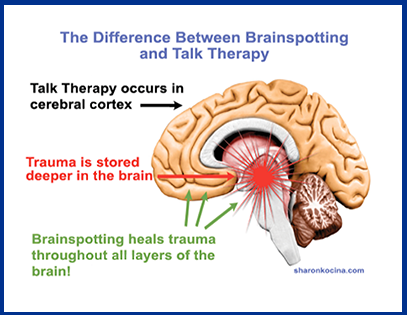
Brainspotting was discovered in 2003 by David Grand, Ph.D. and it is a neuroexperiential model for healing. It is a gentle, powerful, mindfulness-based treatment approach. Brainpotting locates points in the client’s visual field that help access unprocessed trauma, negative emotions and pain, including psychologically induced physical pain in the subcortical brain.
Over 50,000 therapists have been trained in Brainspotting in the U.S. and around the world. Research has proven it to be a highly effective treatment modality. For example, Brainspotting was found to be the most effective mode of therapy used for survivors of the 2014 Sandy Hook Elementary School shooting in Newtown, Connecticut.
👀 What does a Brainspotting session look like?
The success of Brainspotting can be enhanced by using bilateral music, recordings that play quietly in the background through headphones, back and forth from one ear to the other to support the emotional healing process. I provide the music and headphones during our Brainspotting sessions. However, bilateral music is not necessary for the treatment to be successful.
When you come in for a Brainspotting session, with my support, you will choose what you want to heal from or get relief from. You don’t have to talk about it if you don’t want to; even just thinking about it can be sufficient in this part of the setup. That’s the beauty of Brainspotting: you don’t have to talk about the trauma if you do not want to and you can still heal.
Once you have identified your topic, I will guide you to check in with your body to locate where the emotion is showing up. Emotions make themselves known as activation in the body. Everyone is different, and every issue has its own mind-body location, so we check in about that throughout each Brainspotting session.
Then, I might use a pointer to help you locate your Brainspot for the topic you chose. The Brainspot is found along your field of vision and correlates with the intensity of the body sensations. It gives you access to the subcortical, that is the subconscious capsule where the emotional issue content is stored in the mind/body system. Instead of the pointer, we might find a spot you might be looking at in the therapy room as you connect with the activation in your body – we call this a “gazespot”. I will either hold the pointer in place, or encourage you to look at the “gazespot” throughout the next step – watching the internal healing happen as you are processing.
Please know that there is no right or wrong way to feel during a Brainspotting session. Your only job is to notice what comes up for you around the topic you chose as we both “hold the space” for the processing to take place. How this processing manifests is different for each individual. You might want to share what you are experiencing, what body sensations you are feeling, or you might not notice much in your body, or might not want to say much and be silent for long periods of time. You might notice thoughts or memories coming up that might not appear to be related to what you brought up initially in the session. These are just a few of the ways our brain/mind/body systems bring to light stuck places to be released. Your process is unique to you and meets you where you are.
At the end of the processing time, you and I will gently explore your experience of the Brainspotting session: whether new insights came up for you, what feels different now versus before the Brainspotting session, whether action steps became clear for you, or how the original topic might have shifted. These are examples of what we might explore in the debriefing time.
🌱 How do you feel after Brainspotting?
Everyone is different. Some people feel fatigued after a Brainspotting session and want to take a nap. I encourage clients to be kind and gentle with themselves and take it easy for a few hours after a session. The brain and body did a lot of work. There is no right or wrong way to feel. Since Brainspotting works at a deep, subcortical level, it might be a few days, weeks, or even months before you become aware of the healing that takes place in one Brainspotting session. Additionally, once a “capsule” is tapped into during a Brainspotting session, your mind/body system will continue to process and work on the emotional healing long afterwards. Most people feel relief after one Brainspotting session. Longer term issues may need more processing over time.
🧠 Why choose Brainspotting?
✨ Who can benefit from Brainspotting?
If you are new to therapy or have been in therapy before and are seeking a new therapist or a new approach, Brainspotting can treat most mental health concerns. It is especially helpful to those who have experienced emotional or physical trauma. In addition, it can help treat symptoms of anxiety, depression, relational problems, OCD, anger issues, chronic fatigue or chronic pain, grief, phobias, performance anxiety, negative core beliefs, impulse control issues, sports performance issues, and more.
🔍 How can I get help and find a Brainspotting therapist?
If you are in California, let’s see if you and I might be a good fit. I offer Brainspotting sessions in my office in Davis, CA, and also via video for those who can’t make it to my office. To find a professional trained in Brainspotting in your area, you can also check the national Brainspotting website here: https://brainspotting.com/
Explore the transformative potential of Brainspotting and take your next step toward healing!
I look forward to hearing from you!